
Home / Journal / What research says about split keyboards and mouse reach
What research says about split keyboards and mouse reach
We don't want to sell you a keyboard on vague promises. Here's what published research measured, in plain words, with the sources at the bottom.
Split keyboards and wrist angle
Marklin, Simoneau and Monroe measured the wrist and forearm posture of 90 experienced office workers typing on a regular keyboard and on several split designs. On the regular keyboard, wrists bent sideways toward the little finger by about 12° on average. Split keyboards, set up properly, brought that to within 5° of straight.
That sideways bend happens because a regular keyboard is narrower than your shoulders. Splitting the keyboard lets each hand line up with its own forearm.
Mouse position and shoulder muscles
Cook and Kothiyal measured muscle activity in the neck, shoulder and arm while people used a mouse in different positions. When the keyboard had no number pad, so the mouse sat closer to the body, activity in the front and middle shoulder muscles (deltoids) was lower. Their conclusion: for right-handed mouse users, removing the number pad improves working posture.
What these studies don't say
They measured angles and muscle activity in the lab. They didn't test whether any keyboard prevents or treats pain or injury, and neither do we. Mitus keyboards are not medical devices.
How Lagos and Minos apply it
- Two separate halves. Place them at whatever width and angle lines up with your forearms.
- No number pad. Numbers sit on a layer under your fingers, so nothing pushes your mouse further out.
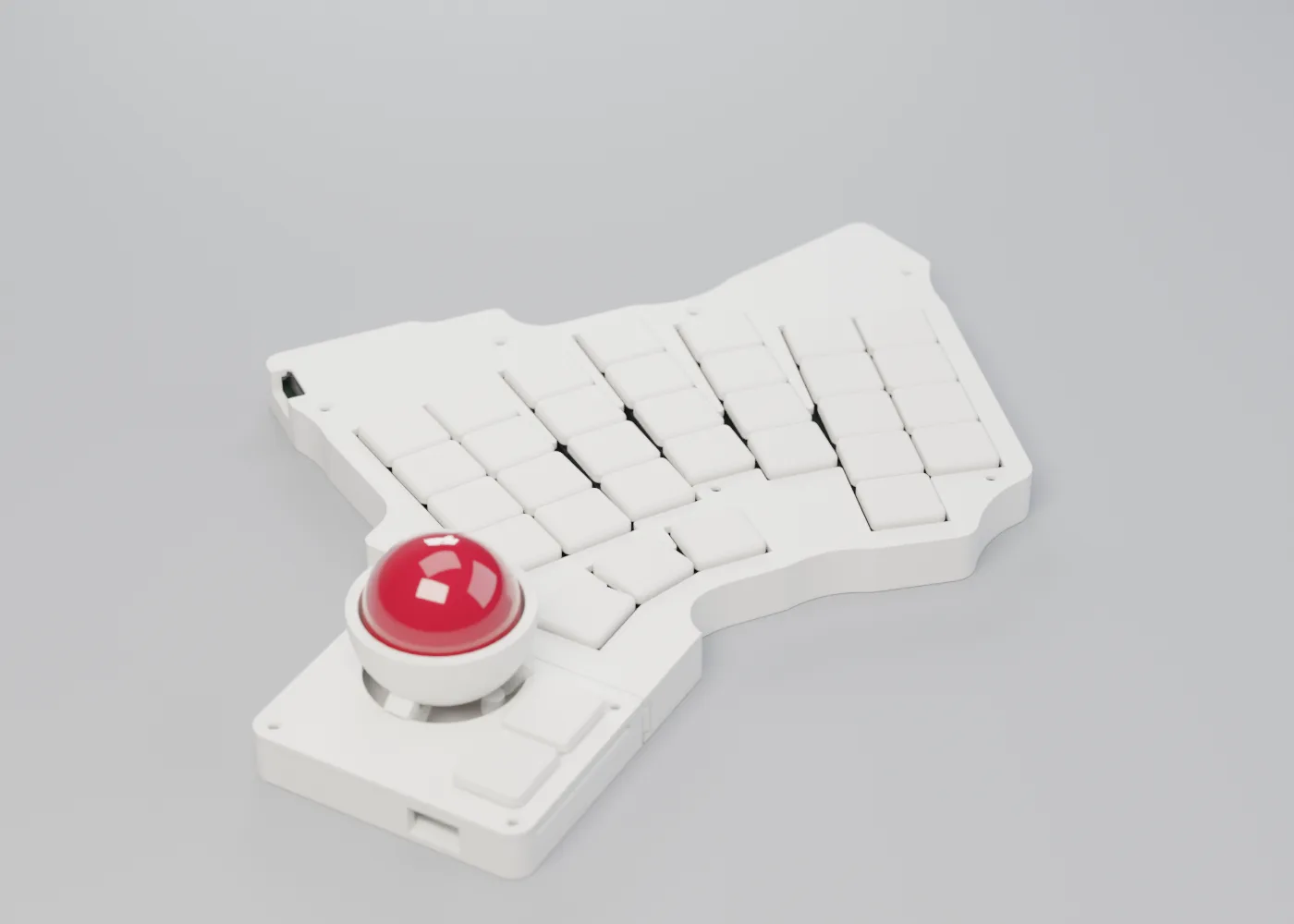
- The pointer under your thumb. On Lagos, a trackball, TrackPoint or touchpad slides into the Mitus Bay, so there's no separate mouse to reach for.
Sources
- Marklin RW, Simoneau GG, Monroe JF. Wrist and forearm posture from typing on split and vertically inclined computer keyboards. Human Factors, 1999; 41(4): 559–569. doi:10.1518/001872099779610978
- Cook CJ, Kothiyal K. Influence of mouse position on muscular activity in the neck, shoulder and arm in computer users. Applied Ergonomics, 1998; 29(6): 439–443. doi:10.1016/S0003-6870(98)00008-8
Designed to keep your hands on the keys.
Lagos (64 keys, with a pointer bay) and Minos (38 keys). Ships assembled. $100 refundable deposit.
Build yours